
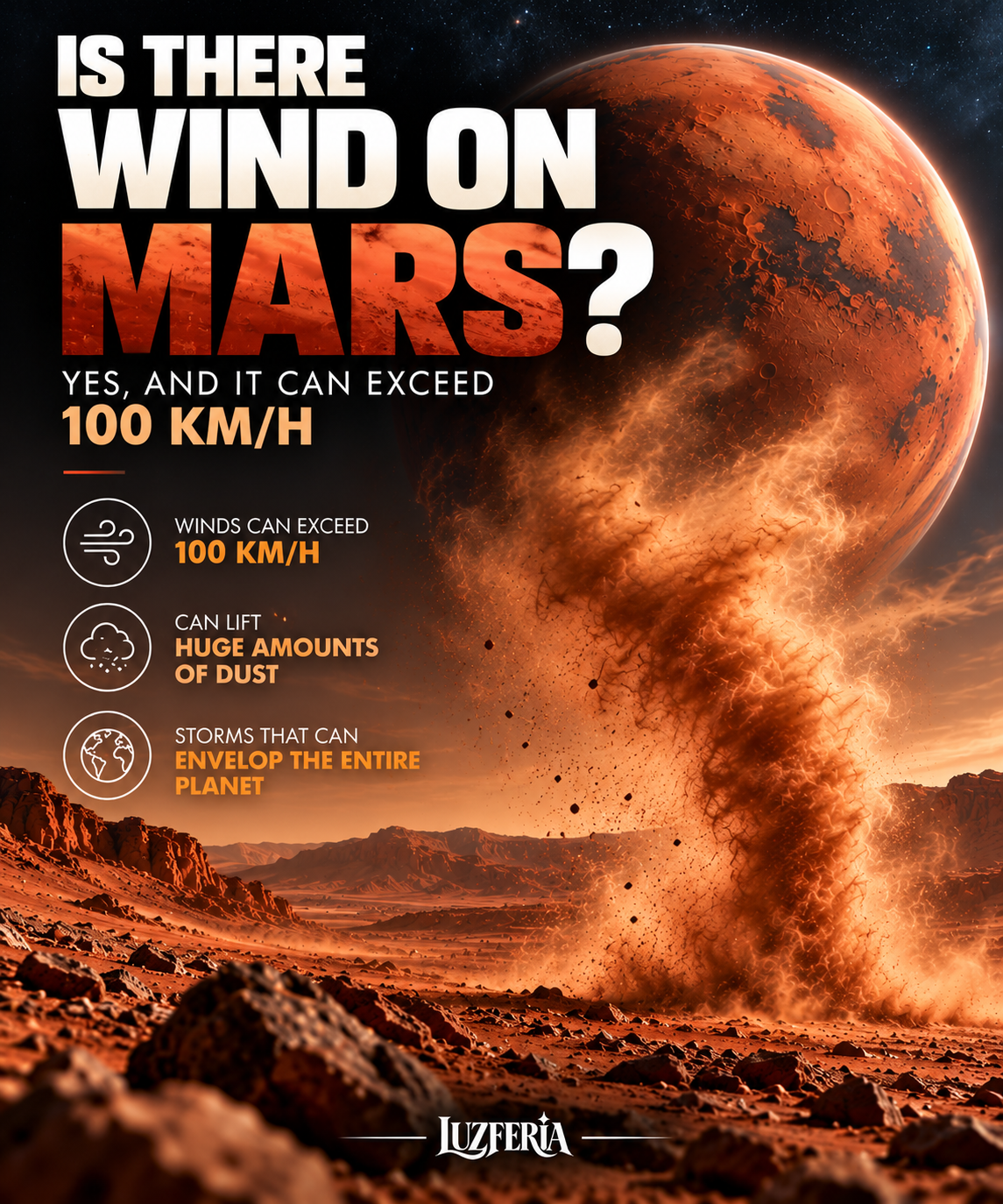
Imagine standing on the surface of Mars as a gust of wind sweeps across the landscape at over 100 kilometers per hour. Reddish dust rises from the ground, whirlwinds cross the desert, and under certain conditions, a storm can spread until it obscures much of the planet.
Yet something makes this scenario extraordinary: the Martian atmosphere is extremely thin. Although Mars has winds capable of moving dust and transforming its surface, they do not exert the same force as winds traveling at identical speeds on Earth.
How is this possible? To understand it, we must explore the Martian atmosphere, the physics of wind, the behavior of dust, and the mechanisms that allow some storms to reach planetary proportions.
1. Is There Really Wind on Mars?
Yes. Mars has an active atmosphere with winds, temperature variations, clouds, whirlwinds, and dust storms. It is not a completely motionless world: its surface changes over time, partly because of wind activity.
Winds on the Martian surface can exceed 100 km/h under certain conditions. These speeds are not constant across the planet; they vary depending on the region, season, topography, and prevailing weather conditions.
The existence of Martian winds has also been confirmed through direct observations. The Perseverance rover, for example, has recorded gusts that move dust across the Martian terrain. Its SuperCam instrument’s microphone has also helped scientists study wind fluctuations and atmospheric turbulence.
Therefore, Martian wind is not merely a hypothesis or an inference based on photographs. It is a meteorological phenomenon observed and studied using scientific instruments.
2. The Martian Atmosphere: Extremely Thin Air
The main difference between wind on Mars and wind on Earth lies in the atmosphere.
On Earth, the average atmospheric pressure at sea level is approximately 101,325 pascals. On Mars, typical surface pressure is around 600 pascals, although it varies with location and season. This is roughly 0.6% of Earth’s sea-level atmospheric pressure.
The atmospheric composition is also different. Mars’s atmosphere consists primarily of carbon dioxide, with smaller amounts of nitrogen and argon. Approximately 95% of its atmospheric gases are carbon dioxide.
But what does it mean to have so little air?
Imagine two air currents moving at the same speed: one on Earth and another on Mars. Even if both travel at 100 km/h, they do not contain the same amount of gas mass per unit of volume. The Martian current contains far less gas, so under comparable conditions, it exerts less force on objects.
This difference is essential to understanding why a seemingly extraordinary wind speed does not necessarily produce mechanical effects comparable to those of an Earth wind.
3. Why Does Martian Wind Exert Less Force?
Wind transfers momentum to the objects it encounters. The force it exerts depends on several factors, including air density, wind speed, and the shape and orientation of the object.
In simple terms, the dynamic pressure of an airflow can be approximated using the following equation:
q = ½ ρv²
Where:
- q represents dynamic pressure.
- ρ is the air density.
- v is the wind speed.
The equation reveals something important: speed matters greatly because it is squared, but the density of the gas matters too.
If density decreases dramatically, the airflow can exert much less dynamic pressure even when moving at high speed. That is why a Martian gust does not necessarily have the force we might imagine when we hear that it exceeds 100 km/h.
This does not mean Martian wind is harmless. Dust can affect instruments, coat surfaces, interfere with observations, and reduce the sunlight reaching solar-powered equipment.
The conclusion is more subtle than it first appears: wind speed alone is not enough to determine how powerful a wind is.
4. The Mystery: How Can Wind Lift Dust in Such a Thin Atmosphere?
This is one of the most interesting questions in Martian meteorology. If the air is so thin, how can it lift particles from the ground and keep them suspended?
The answer involves several mechanisms, including wind stress on the surface, the movement of sand grains, turbulence, and convective whirlwinds.
Wind Can Set Sand in Motion
When wind exerts enough stress on the ground, some grains begin to move. Sand grains can hop and fall back onto the surface, striking other particles and transferring energy to them. This process, known as saltation, helps mobilize smaller particles that can subsequently become airborne and travel long distances.
Research into Martian aeolian processes has shown that wind can reshape dunes, rearrange sediments, and even contribute to rock erosion.
Whirlwinds Also Lift Dust
Another important mechanism involves dust devils. These whirlwinds form when surface heating generates convective air movements and, under suitable conditions, rotating vortices that concentrate airflow.
These whirlwinds can lift dust and transport it vertically. Some reach considerable heights and leave visible tracks on the surface.
Both surface wind stress and convective vortices are recognized mechanisms of dust lifting on Mars.
There is no need to imagine wind powerful enough to tear enormous rocks from the ground. Under the right conditions, it can mobilize small particles and keep them circulating.
5. Dust Storms That Can Envelop an Entire Planet
Mars frequently experiences local and regional dust storms. Sometimes these systems expand or combine to form global storms that cover much of the planet and obscure large portions of its surface.
One of the best-known examples occurred in 2018. A major dust storm spread across Mars, eventually covering extensive areas of the planet. The event had serious consequences for space exploration: the solar-powered Opportunity rover stopped communicating during the storm, and its mission ended after recovery efforts proved unsuccessful.
But how can a storm grow so large?
The explanation involves a feedback process between dust and the atmosphere.
- The Sun heats the surface. Heating creates temperature differences and encourages air movement.
- Wind lifts particles. Dust moves from the ground into the atmosphere.
- Dust changes the distribution of heat. Suspended particles absorb and scatter sunlight, altering temperatures in the atmosphere and at the surface.
- Atmospheric circulation changes. Temperature differences can modify winds and encourage further dust transport.
In this way, dust is not simply something carried by the storm. It can also influence how the storm develops.
However, this mechanism does not mean every storm will become global. Its evolution depends on weather conditions, season, dust distribution, and other atmospheric factors.
6. Why Does Dust Remain Suspended for So Long?
Mars’s surface gravity is approximately 38% of Earth’s. This affects how particles fall, although gravity is not the only factor determining how long they remain airborne.
Martian dust can remain suspended for weeks or even months. Gravity influences particle settling, while particle size, turbulence, and atmospheric circulation affect transport and dispersion.
It is important to clarify one point: a thinner atmosphere does not automatically keep every particle airborne. Suspension depends on particle size and properties, the forces acting on the particles, and atmospheric turbulence.
What makes Mars remarkable is that these processes, acting together, allow substantial amounts of fine dust to spread through and persist in the atmosphere.
7. What Would Happen if a Person Were Exposed to Martian Wind?
Science-fiction movies sometimes depict Martian storms powerful enough to knock over vehicles or sweep astronauts away. However, these scenes exaggerate the mechanical force that wind would exert in the real Martian atmosphere.
Because of its low density, a Martian gust at a given speed would exert much less dynamic pressure, under comparable conditions, than an Earth gust moving at the same speed. Even the strongest Martian storms would therefore behave very differently from terrestrial hurricanes.
That does not mean an astronaut could safely venture outside without protection. Mars’s atmosphere is not breathable, its surface pressure is extremely low, and temperatures can be bitterly cold. Dust also poses a problem for mechanical systems, electronic equipment, and solar power generation.
The main danger would not necessarily be the wind throwing a person through the air. Rather, it would be the combination of extreme environmental conditions and the cumulative effects of dust on technology and human operations.
8. Wind Also Shapes the Martian Landscape
Martian wind does more than produce spectacular storms. It is also one of the forces that has shaped the landscape over time.
Dunes, ripples in the sand, dust deposits, and certain markings on rocks provide clues about wind direction and intensity. By studying these structures, scientists can reconstruct aspects of atmospheric behavior and the evolution of the surface.
Observations from rovers and orbiting spacecraft have documented how sediment transport modifies the terrain and how atmospheric conditions leave visible traces.
These findings are important because Mars preserves geological records of processes that also occur on Earth, but under very different physical conditions.
In a sense, studying Martian wind is like studying an alternative version of terrestrial meteorology: a natural laboratory in which gravity, atmospheric pressure, temperature, and air composition change the practical rules of weather.
Conclusion: Fast Wind Is Not Always Powerful Wind
Yes, there is wind on Mars. Under certain conditions, it can exceed 100 km/h, transport dust, generate whirlwinds, and contribute to storms capable of covering enormous regions of the planet.
However, the atmosphere is so thin that wind exerts much less force than an Earth airflow traveling at the same speed. The interaction between wind, particles, the surface, and solar heating helps explain how such spectacular phenomena can occur in an environment with such low atmospheric pressure.
Mars teaches us a fundamental lesson in physics: to understand a phenomenon, measuring its speed is not enough; we must also understand the medium in which it occurs.
A gust of 100 km/h may represent the same numerical speed on two planets, but the physical conditions that determine its effects are radically different.
References
- NASA. (n.d.). Dusty Differences Between Mars and Earth. https://science.nasa.gov/earth/earth-observatory/dusty-differences-between-earth-and-mars-149926/
- NASA. (n.d.). The Fact and Fiction of Martian Dust Storms. https://www.nasa.gov/solar-system/the-fact-and-fiction-of-martian-dust-storms/
- NASA. (n.d.). Dust Cycle. https://www.nasa.gov/general/dust-cycle/
- NASA. (n.d.). Dust Lifting and Dust Cycle Modeling. https://www.nasa.gov/general/dust-lifting-and-dust-cycle-modeling/
- NASA/JPL. (n.d.). Mars at a Glance. https://www.jpl.nasa.gov/news/press_kits/insight/landing/facts/mars-at-a-glance/
- Stott, A. E., et al. (2023). Wind and Turbulence Observations With the Mars Microphone on Perseverance. Journal of Geophysical Research: Planets. https://doi.org/10.1029/2022JE007547
- Nature. (2005). Aeolian processes at the Mars Exploration Rover Meridiani Planum landing site. Nature. https://www.nature.com/articles/nature03641
Note: The maximum wind speeds cited are estimates or gusts documented under specific conditions, not constant speeds across all of Mars. Atmospheric pressure also varies with altitude, season, and location.
Deja una respuesta