
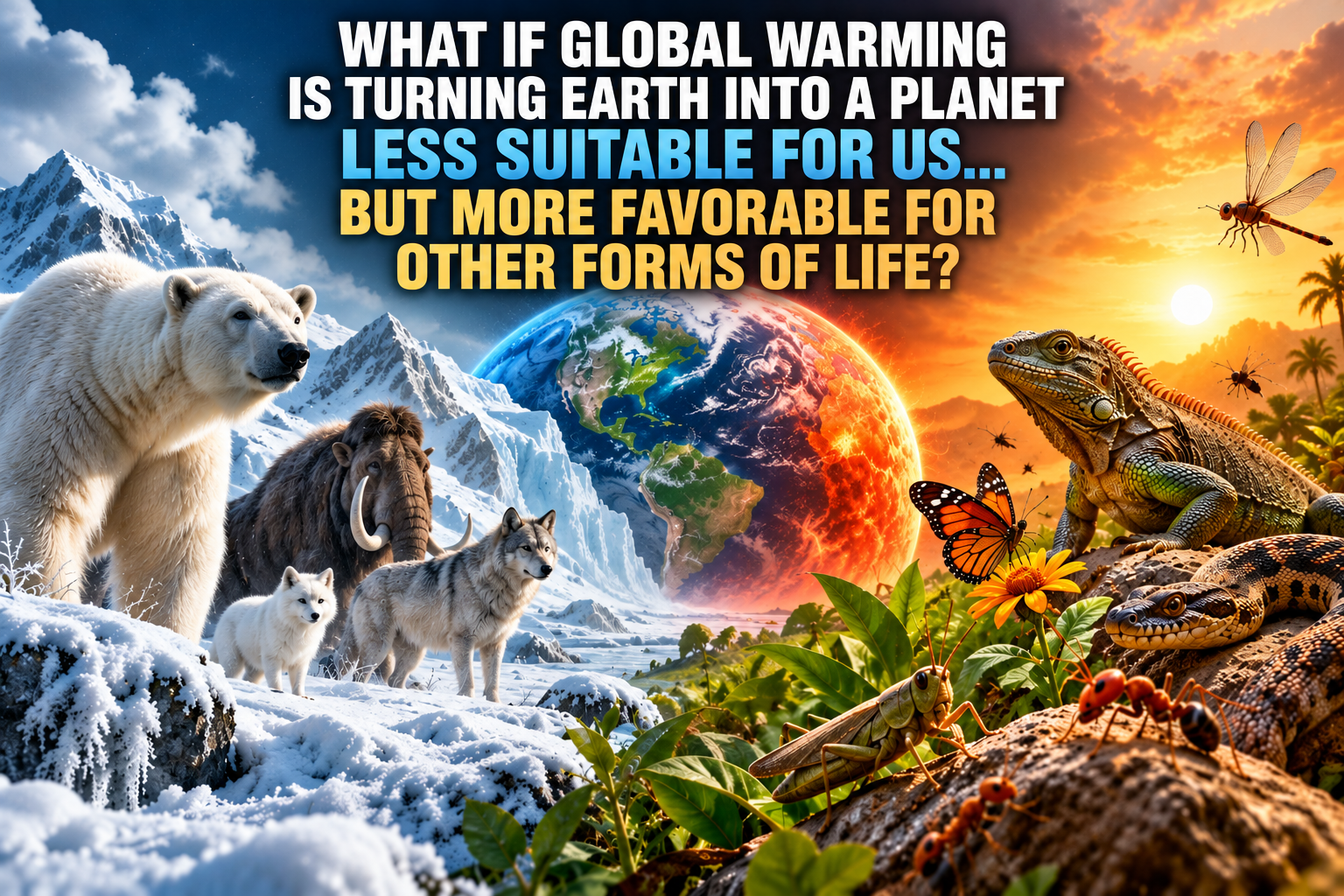
There is a fascinating paradox in the history of life: not all organisms thrive under the same environmental conditions.
And perhaps we are altering the balance that made the ecosystems we depend on possible.
LET’S OPEN THE DEBATE.
1/ Are mammals designed for cold environments?
Think of a polar bear, a mammoth, or a human being.
Mammals are warm-blooded animals: we generate heat and regulate our body temperature even when the surrounding environment gets cold.
This ability allows us to live in freezing regions, but it comes at a cost: we need energy to keep our bodies functioning.
And here is the paradox: the same adaptation that allows us to withstand the cold has its limits when environmental temperatures become extreme.
2/ What happens to cold-blooded animals?
Many reptiles and arthropods rely more heavily on environmental temperatures to regulate their activity.
When conditions are suitable, warmth can accelerate their metabolism, development, and, in some species, reproduction.
That is why certain insects and reptiles may benefit from higher temperatures.
But there is a catch: this does not mean all of them thrive as the planet warms. Excessive heat can kill them, too.
It all comes down to their physiological limits.
3/ Life existed long before mammals dominated the Earth.
Bacteria emerged billions of years ago. Arthropods and reptiles appeared long before modern mammals diversified.
Throughout its history, our planet has experienced periods considerably warmer than today, during which extraordinarily diverse ecosystems existed.
But there is an important detail: being an ancient group of organisms does not mean being better adapted to heat.
Evolution does not work like a ladder in which newer organisms replace older ones. Every species adapts to its own environment.
4/ So, what are we doing to the planet through global warming?
We are changing the conditions that determine where species can live, reproduce, and find food.
In certain regions, warming can encourage the spread of some insects, pests, parasites, and disease vectors.
At the same time, it can destroy cold habitats, harm species that depend on them, and disrupt entire ecosystems.
We are not necessarily creating a planet with more life.
We are changing which forms of life can thrive and which are put at a disadvantage.
5/ What about mammals?
Mammals are not exclusively cold-climate animals. Many species thrive in the tropics, and humans can adapt to heat to a certain extent.
However, our ability to regulate body temperature has limits.
Heat waves, especially when high humidity makes it harder for sweat to evaporate, can become life-threatening.
There are also indirect consequences: water shortages, agricultural losses, wildfires, and disruptions to the ecosystems we depend on.
Technology protects us, but it does not make us invulnerable.
6/ Does this mean global warming is good for life?
Not necessarily.
A warmer Earth is not automatically a more biologically diverse Earth.
Some species may expand while others disappear. Certain insects may proliferate while others suffer from thermal stress. Coral reefs may bleach, and food webs may become destabilized.
The outcome is not simply a replacement of mammals by reptiles, or complex animals by simple organisms.
It is a transformation of entire ecosystems.
7/ The real problem may be the speed of change.
Earth has experienced major climate shifts throughout its history, and life has survived many of them.
But organisms need time to adapt, migrate, or evolve.
When the environment changes too quickly, many species cannot respond in time.
And we depend on relatively stable ecosystems for water, food, and other essential resources.
8/ The final paradox.
Imagine a planet that still supports life, but where many of today’s species can no longer survive in their original habitats.
A planet where certain organisms expand, others retreat, and familiar ecosystems disappear or transform.
Would it still be habitable?
Yes, for many forms of life.
Would it remain just as habitable for us?
Not necessarily.
Global warming does not have to destroy all life to radically transform the world we can live in.
And that may be one of the most unsettling ideas to emerge from this discussion.
QUESTION FOR DEBATE:
If Earth can continue supporting life under very different conditions, are we confusing the survival of life on this planet with the survival of the ecosystems that make our civilization possible?
What do you think?
#Science #ClimateChange #Evolution #Biology #PlanetEarth
Deja una respuesta